The number people search for is a single figure. The number that decides what you actually pay is a list, and the two clinics quoting you are almost certainly not listing the same things.
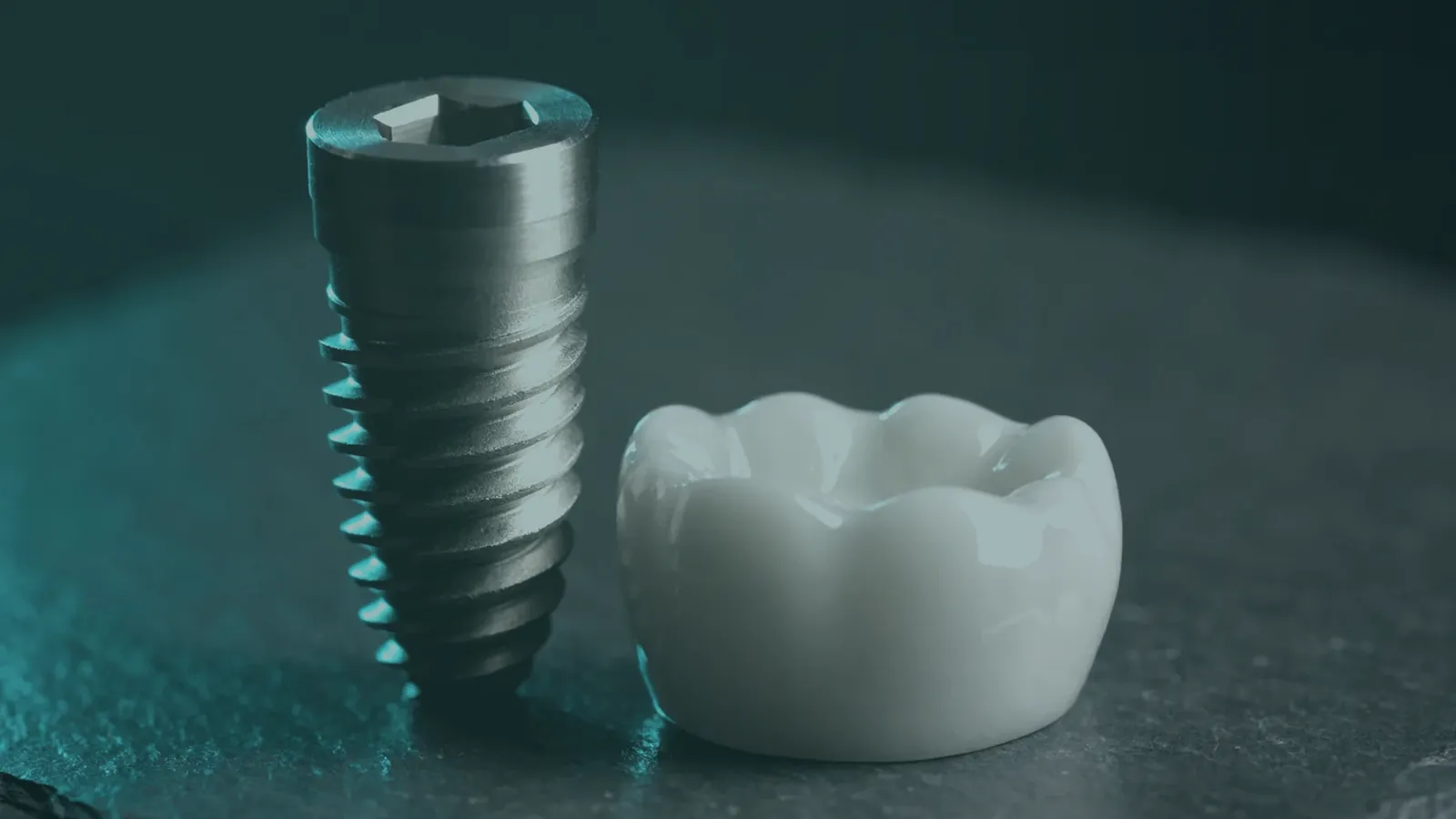
A dental implant is not one item. It is a titanium fixture placed in the bone, an abutment that connects to it, and a crown on top — three components, often from three different manufacturers, at three different price points. A quote that says “implant: £450” has told you about one of them.
The three parts, and what each one changes
The fixture is the screw. Its brand is the single biggest driver of price and the single biggest driver of what happens to you in fifteen years, because a fixture from a company that still exists is a fixture whose replacement parts you can still buy.
| Component | What it is | Why the price moves |
|---|---|---|
| Fixture | The titanium screw in the bone | Brand, surface treatment, and whether spare parts will exist in 15 years |
| Abutment | The connector between fixture and crown | Stock or custom-milled; custom costs more and fits better |
| Crown | The tooth you can see | Material — zirconia, e.max, metal-ceramic — and who made it |
Premium fixtures — Straumann, Nobel Biocare, Astra — cost the clinic three to five times what a budget Korean or Turkish fixture costs. That difference is real and it is defensible. What is not defensible is a clinic quoting a premium price and placing a budget fixture, which is why the brand should be named in writing before you travel and why you should leave with the implant passport that names it.
What the headline price usually excludes
Read any quote against this list. Every item on it is something a clinic can legitimately charge for separately, and something a cheap headline figure has usually left out.
- The CBCT scan — the 3D scan that decides whether an implant is possible at all
- Extraction of the tooth being replaced, if it is still there
- Bone graft or sinus lift, which a third of upper-back cases need
- The abutment, quoted separately surprisingly often
- The crown, which on some quotes is a separate line and on others is not there at all
- The temporary tooth you wear for three to six months
- Follow-up appointments and the final fitting trip
Why the Turkish figure is lower
The saving is real and it is not mysterious. Roughly, in order of size: clinical salaries in Turkey are a fraction of UK or German ones; commercial rent in Istanbul is a fraction of central London; the lira has lost value against the pound and the euro, which shifts the exchange rate in your favour before anyone has done any dentistry; and Turkish clinics run at volumes that keep chairs and CBCT scanners occupied all day rather than half of it.
None of those are about the implant being worse. All of them are about where the building is. That is also why the saving is largest on the most labour-intensive treatments — a full arch, where the difference can be £10,000 — and smallest on a single crown, where it might be £120.
Comparing two quotes properly
Put them side by side and normalise them before you compare a single number. Ask each clinic for the same five things:
- The fixture brand and model, written down
- The crown material, and who mills it
- Whether grafting is included or would be extra, and how they will know
- The total number of days in Istanbul, across how many trips
- The warranty: what it covers, for how long, and what you would have to pay for
A clinic that answers all five in writing within a day is telling you something about how it will behave when you have a problem in eighteen months. A clinic that answers with a discount is telling you something too.
The trip is part of the price
Flights, a hotel for five to seven nights, transfers, and the time you take off work are real money and belong in the comparison. For a single implant they can erase the saving entirely. For a full arch they are a rounding error against a five-figure difference. Work out which case you are in before you get attached to the headline number.
What the fixture brand actually buys
This is where most of the price difference between two Turkish quotes lives, and it is the least understood part of the bill. All implant fixtures are titanium screws. What separates them is the surface treatment, the volume of published clinical data behind them, and whether the company will still be selling compatible parts in twenty years.
| Tier | Examples | What you are paying for |
|---|---|---|
| Premium | Straumann, Nobel Biocare, Astra Tech | Decades of published survival data, global parts availability, surfaces with the most evidence behind them |
| Mid | MIS, Dentium, Osstem | Solid clinical records, widely used, parts generally obtainable |
| Budget | Various regional brands | Works. The risk is availability of components in fifteen years, not failure next year |
The practical consequence is not whether the implant integrates — most modern fixtures integrate reliably. It is what happens when an abutment screw fractures in 2041 and your dentist needs a replacement part. With a premium system, any competent dentist anywhere can order one. With a discontinued regional brand, the options narrow to removing an integrated implant from healthy bone, which is a far bigger procedure than the one that put it there.
A worked example
One missing upper premolar, no grafting needed, single implant with a zirconia crown. Here is how a complete quote breaks down against a headline figure, using indicative numbers rather than a promise.
| Line | In a headline quote? | Why it matters |
|---|---|---|
| CBCT scan | Sometimes | Decides whether the plan is possible at all |
| Fixture | Yes — this is usually the headline number | Brand should be named |
| Abutment | Often not | Custom fits better than stock and costs more |
| Crown | Often a separate line | Material and laboratory both matter |
| Temporary | Rarely | You wear it for three to six months |
| Second-trip fitting | Rarely | A flight, a hotel and time off work |
Two quotes can therefore differ by a factor of two while describing exactly the same clinical outcome, simply because one of them has listed six lines and the other has listed one. That is not dishonesty in most cases; it is an industry convention that happens to favour whoever quotes least.
Why the same clinic quotes different people differently
Because the treatment differs. Bone volume decides whether grafting is needed; the position in the arch decides whether the sinus is involved; your bite decides the crown material; whether the tooth is still present decides if there is an extraction. A clinic quoting everyone the same number for “an implant” is quoting a component, not a treatment.
This is also why a price given from photographs should be treated as a range, and why a clinic that says so is being more honest than one that gives you a firm figure before it has seen a scan.
Payment, deposits and currency
- Expect to pay a deposit to hold surgical dates. A deposit is normal; a demand for the full sum before you arrive is not.
- Ask which currency the quote is fixed in. A lira-denominated quote can move meaningfully between quotation and treatment.
- Pay the balance by card where you can. Card payments carry chargeback rights that a bank transfer does not.
- Get a receipt itemised the same way as the quote, so the two can be reconciled.
When travelling does not make financial sense
It is worth saying plainly. For a single crown, or a single implant where you already have a dentist you trust at home, the saving after flights, hotel and two trips can be small enough that the convenience of local treatment wins. The arithmetic turns decisively in favour of travelling when the treatment is large — multiple implants, a full arch, a full-mouth reconstruction — because the saving scales with the clinical time while the flights do not.
Do the sum with real numbers before you decide, and be willing to conclude that your case is one of the ones better done at home. A coordinator worth dealing with will tell you the same thing.